Natalia Kraevskaia
“Time Out of Joint”, an exhibition by five contemporary Australian women artists is open in Hanoi University of Fine Arts from April 9 to 17. The focus of the works at the exhibition is an exploration of the significance and impact of memories, of their subjectivity and their liaison with common culture and history. According to curator of the exhibition Carmen Grostal, women are often regarded as the cultural links between the generations. They pass on traditions, customs and family rituals, using memory and narrative in order to overcome geographical and social dislocation.
At the opening of the exhibition the Australian Ambassador, Mr. Joe Thawaites, has accentuated that Australia’s history is one of migration. “Many Australians have a sense of dual identity, dual culture, – he said. – With 25% of Australians having been born overseas, and 43% of Australians having one parent born overseas, the impact of immigration on modern Australian is profound”.
Three of the participating artists were born in Vietnam and now returned to the country of birth to share their life and artistic experiences. Two other artists have the multicultural background as well. The difference of their memories – the perception of time and travel, childhood recollections and impressions from another culture – paradoxically stresses their similarity as of those who familiar and connected to more than one heritage.
An assemblage of Hanh Ngo, which includes her tapestry weaving based on motives of ancient ceramics, transforms her fragmented memories into a jigsaw puzzle looking art piece, dealing with discontinuity of the migrant’s life, with fragile illusions and the deception of imagination.

Hanh Ngo: China (detail), 1999 (tapestry -cotton, twine, engraved polycarbonate, graphite, pins 600 x 4000 cm)
Her attempt to rejoin the physical and ideal patterns from her memories into the whole image echoes with the concept of Helga Groves’ wall installation which links extremely distant places and times. It was here in Hanoi during her art residency, than the Australian born artist got as a present a copy of The Kalevala, Finnish epos in Vietnamese translation, which reminded her about her roots. This coincidence served as a catalyst for her new work for the exhibition through which the artist expresses her emotional ties with definite places.
This geography of memories is also a source of another work, “Untravelled roads ” by Caroline Ho Binh Tuyen Dang. Her map based images share notions of migration, memory and time.
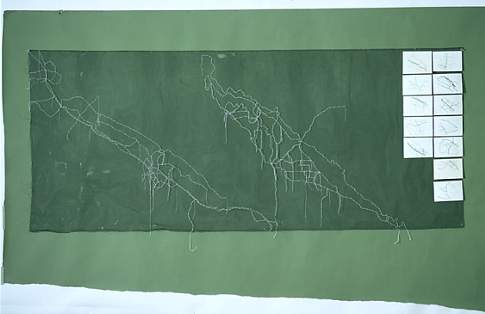
Caroline Dang: Untravelled Roads, 2002 (Fly-screen, cotton string, gouache on paper, 130 x 235 cm)
The works by two other artists – Trinh Vu and Nelia Justo – reflect the artists’ investigation of the impact of technology on art. “The Dot Painting” by Trinh Vu links an old-age domestic printing technology with computer technology demonstrating the artist’s recent research on similarity and difference.
Nelia Justo uses the electronic medium as a means of showing relations between the historical and contemporary. Her sculptural works focus on historical dynamics of Asian and European interactions. Her recent works represent her metaphorical interpretation of trade goods between Asia and Europe and its effect on technological development.
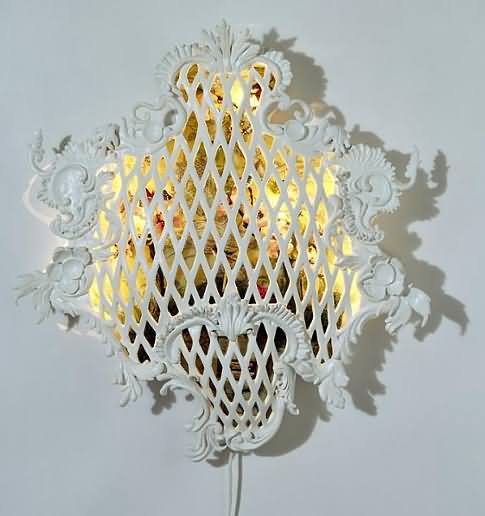
Nelia Justo: The Garden of Perfect Brightness, 2002 (Paier-mâché, MDF, cloth, found objects, resin-based paint, electronic components, alkaline batteries, power supply, 63 x 60 x 10cm)
The exhibition “Time out of joint” is a significant event for the Hanoi art community because it brings to the public an expression of contemporary multicultural Australia creating a cultural bridge between Australia and Vietnam. This exhibition at the Fine Arts University also provides the opportunity for a young generation of artists and art students to experience completely different approach to the creation of art from the one they were taught in school. I watched the reaction of students at the show opening: they looked confused, and perhaps surprised and may be thought – is it also art? At the same time they were willing to try and grasp the codes and metaphors which are the foundation of the Australian artists aesthetic. They had a chance to discover the possible combination of different media in one work as well as the combination of casualty and rational reflection embedded in the process of forging the concept of time and memory.
Regarding the relatively rareness of such events in Hanoi, it’s a pity that the Fine Art Institute didn’t use the chance of the presence of two Australian artists and the curator of the exhibition (who had been eager to share their art experience with Vietnamese artists) to organize a forum, conference or a simple discussion similar to those which often accompany art exhibitions in Goethe Institute, Alliance Francaise or Hanoi Contemporary art center. Crossing the old stepping-stones of traditional academism in solitude and isolation is not an easy task.
Touching the unfamiliar interpretations of ideas into art, discovering the unconventional use of various media, young Vietnamese artists , I hope, will go ahead in their own experimentation without frustration, without fear of slips and momentary failings.
The museum or gallery will never be the best place to experience the notions and unconscious perception of time and space. Though the key goal of the exhibition – to find the visual equivalent of rejoining different moments and locations – had been creatively shaped through experimental attempts to capture movement, changes, past and present.
© 2003 talawas


 bản để in