Charles Merewether
From now on, I’m no longer human…not an ordinary person.
Wang Shuo
At the beginning of May 2001, the Chinese Ministry of Culture issued a public memorandum of concern about contemporary art. The statement issued singled out contemporary art that used animal parts, blood or human bodies, stating, “Some people have made bloody, violent and erotic performances by abusing themselves or animals and exhibiting human corpses in public places in the name of art.” Artworks of this kind “violate state laws, upset social order and damage people’s mental and physical health. Performances broadcasting pornography, superstition and violence are prohibited.” Moreover, the memorandum drew attention to a series of Constitutional Articles pertaining to the “rules of social morality,” especially pornography and obscene or licentitious behavior. Of the many Articles, Article 302 stated, “Anyone who steals or violates a corpse will be sentenced to imprisonment for up to three years, or be put under public surveillance.” Article 22 reads as follows: “The State forbids the organization and presentation of the following performances with the following content,” including “to present horror or cruel shows in which actors/actresses are compromised physically or mentally.” The organizers of such exhibitions were subject to jail sentences of up to three years for anyone organizing “erotic” performances and up to ten years for “more serious crimes.”
This governmental response came in the immediate wake of a series of recent exhibitions from Corruptionists (Beijing, November 1998), Post-Sense: Sensibility, Alien Bodies and Delusion, (Beijing, January 1999), Life and Culture (Beijing, August 1999) to Food as Art (Beijing, February 2000), Obsession with Harm (Beijing, April 2000), Man and Animals (Beijing, Chengdu, Guilin, Nanjing, Changchun, 2000), Useful Life (Hangzhou, 2000); and followed by two “unofficial” exhibitions. Fuck-off’and Unusual and Usual held simultaneously with the 2000 Shanghai Biennale.
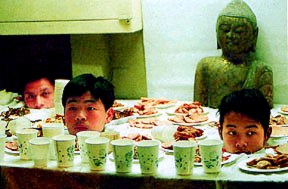 |
| Figure 1. Qiu Zhijie, All the Meat Here Is Clean, 2001. Courtesy of the artist |
Curated by Wu Meichun and Qiu Zhijie, the exhibition Post-Sense was held in one of Beijing’s hundreds of apartment blocks in the Peony residential district, rather than in a downtown and foreign-owned gallery (fig. 1). Occupying a disused basement, the impoverished character of the space became integral to the subject of the work. Pocket Theology by Zhu Yu displayed a severed arm that hung from a grappling hook attached to the ceiling in one of the empty basement rooms. Extending down towards the floor, the hand grasps a long rope that hangs beside it. Sun Yuan’s work Honey occupied another similarly disused room with a wrought-iron bed, on which lay a severed head of an old man and alongside which, as if whispering in his ear, lay a shriveled corpse of a still-born child on a slab of ice. In an interview. Sun Yuan remarked, “I want to use real things because I want people to stop and not be numb anymore…” [1]
Other comparable installations or performances include that of Gu Dexin (one of the artists showing in the “Usual” section of the exhibition Unusual and Usual}, whose work entailed a video showing tables of raw pork soaked in blood. Correspondingly, we may point to Peng Yu’s performance (in Obsession with Harm) of dropping oil extracted from human fat into the mouth of a medical specimen of a child corpse, or her Curtain piece, composed of a one thousand live bullfrogs, grass-snakes and lobsters, each pierced through the stomach with wire and then hung up. Alternatively, Yang Zhichao planted seeds in self-induced cuts in his body, while Yang Zhenzhong produced a video entitled I Will Die (2000), in which people, speaking gently and with smiles on their faces, acknowledge that they will die. Installed within the sphere of housing estates where tens of thousands of Chinese live a life of relative anonymity and impoverished living conditions, art becomes an arena for rehearsing endgame scenarios that shock people into confronting the realities of everyday life, and the threat to and instability of human life. More specifically, such work exposed the extreme discrepancy between the residual condition of a daily life of low wages and standard of living for the majority of people, and an over-inflated market economy of conspicuous consumption for a minority.
A contemporary malaise
What is striking about the recent Chinese art is the appearance of what may be called the posthumous subject, whose’death constitutes not simply the negation of subjectivity-i.e., alienation, anxiety-but its disappearance altogether into the post human selfhood. This condition implies a subject drained, as it were, of emotion, of memory, an amnesiac subject whose modus operandi becomes one of survival and conformity. There is something so vehemently unconstrained about these tableaux, so violently confrontational as to the limits of human endurance or human life that it demands its rejection. Moreover, viewed within China, there is something profoundly nationalistic in the way such artwork confronts its own people and government. In provoking tremendous reaction from all quarters of the public and public sphere, it was as if this violent anti-aesthetic had broken the taboos governing the practice of art and, the unspoken social conventions and mores governing the necessary civility culture needs to legitimate itself and be seen within the public sphere.
The governmental response was not simply to officially condemn but, in one case, close down an exhibition as dangerously morbid, and therefore harmful to the Chinese public. The art was hence interpreted as foreign, impure, polluted in a way that would cause moral and spiritual harm. Only minutes before it was due to open, the exhibition Life and Culture was closed down by the Public Security Bureau, who suspected that a secret meeting of the Falun Gong religious sect was being held.
The reaction from within the art world has been no less concerned and swift to condemn this art as coming under the bad influence of recent contemporary art in the West.[2] In a recent article entitled “Contagious Desire,” the Beijing-based critic Karen Smith argued that the origin of recent artworks containing scenes of violence and concern the subject of death is an offshoot of contem-porary Western art, as distinct from works that “represent a truly original ‘Chineseness’.[3] Smith sees the work as closely paralleling Western performance art and artists, especially that of Damien Hirst and recent exhibitions, notably Sensation and Apocalypse, both held at the Royal Academy in London in 1997 and 2000, respectively. The Chinese “reworking of clearly traceable sources of inspiration'” means “broader insights are conspicuously absent.[4] But then for Smith, this is understandable for while the origin of Western contemporary art is based on religious taboo, there is a “lack of a spiritually constraining paradigm in China, of a godly morality that might deter acts of self-mutilation, the adulteration of flesh and natural forms, living and dead, and the use of human corpses.[5] Hence, she concludes that, although there are social taboos governing contemporary China that include “spiritual and ideological pollution, adverse political comment, pornography and superstitious faiths,” the “use of animals and the human body in art is not a moral issue.[6] It is rather a “chamber of horrors (rather) than a spiritual-intellectual exercise in art,” symptomatic of what she calls a “godless society” that “swings like a pendulum between superstition and moral anarchy.[7] For Smith, such anarchy is the result of “socialist rule that in its early stages destroyed all cultural, social and individual ethics, integrity and principle on which several thousand years of civilization rested.[8] Hence, although the author locates the work as symptomatic of Chinese socialism (as distinct from communism), the terms of her critique are the same as those of the Chinese Ministry of Culture, itself representative of the government about whom she is critical.[9] Similarly, in an article “How to deal with rights… published online, the artist/writer Wang Nanming has suggested that the contemporary art world has “decorated with the lipstick of performance art” the “human rights disaster” of Mao’s Cultural Revolution.[10] Moreover, for Nanming, it is symptomatic of the exhaustion of Chinese contemporary art that, after pandering to the West, it turns to the “tradition of Mao’s ruffian politics: a type of politics characterized by its use of power to violate rights.[11] This tradition continues to “violate human rights in a society that has no human rights in the first place.” By citing the “tradition of Mao’s ruffian politics,” signifying here especially the initial period of the Cultural Revolution dominated by the violence of the Red Guards, the author foregrounds also what became known as the “liumang culture,” a phenomena within the period of Deng’s Reform era. As the Chinese scholar John Minford described it at the time, this generation-the liumang generation-is a “lost generation…the children of the Chinese holocaust,” composed of “rapist, whore, black-marketeer, unemployed youth, alienated intellectual, frustrated artist or poet.[12]
For many of these commentators, while this generation represents the legacy of violence produced by the Cultural Revolution, it is for them the impact of Western values on China that has fostered a climate in which moral corruption thrives. The West as an overarching concept, in other words, is used as the foil against which something identifiably Chinese is made. Huang Du in his catalogue introduction to the exhibition Post Material at Red Gate Gallery-an exhibition that included work of a similar nature to Post-Sense-observed that Chinese art of today can be understood better if viewed within a situation of global environmental pollution brought about by technological advancement. [13] Likewise, Zhu Qi, in the catalogue essay of an exhibition entitled Time of Reviving and held at the Upriver Gallery in Chengdu, wrote that the artwork reflected a condition of “post-subjectivity” resulting from an “invasion of capitalist information and globalized experience.”[14]
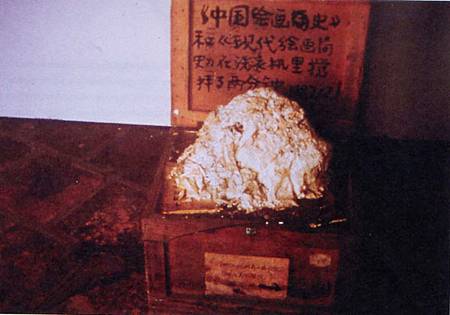 |
| Figure 2. Huang Yongpin, History of Chinese Painting and Concise History of Modern Painting Washed in a Washing Machine for Two Minutes, 1987, installation |
Alternatively, the gallery Director Chen Jiagang seeks to establish a more mediated reading that as reflected in the exhibition title, implicitly defends the work as a process of cultural consumption insofar as it functions to renew Chinese culture. He writes, “the subject matters reflect the profound changes of a self-reviving Chinese social system during the transitional period during the 1990s in the fields of visual images, aesthetic orientation, and subjectivity. Through such changes, we could see the fundamental impact of the free market, globalized reality and the remaining of the political society in the 1990s” [15] Contemporary Chinese art is, in other words, seen as directly symptomatic of the West, either subject to pollution, invasion or unavoidable consumption.
Without doubt, since 1979 when Deng Xiaoping ushered in his open door policy of economic reform. Western consumer culture has seized not only the popular imagination but also cultural values m general; to the degree that many feel that it has corrupted Chinese values. Moreover as the free market economy of the Deng era de-legitimated or deregulated high culture in favour of mass consumer culture, Chinese artists turned westward. They began to not only reproduce Western trends and earn their living from selling them back to an overseas audience, but the majority of contemporary art in China continues to be bought by foreigners either directly from the artists or through foreign-owned galleries in China.
As a result, this trend has been seen as a kind of export art that, emerging out of the Reform era properly belongs to the international market place rather than to a local Chinese context What’ these authors have in common is the idea that a consumerist-oriented global culture has, in some manner, polluted or destroyed subjectivity, producing a post or anti-humanist condition Within this framework, their argument implies that contemporary culture becomes instead a shallow reflection of Western values and loses touch with something of an essence of what constitutes Chinese. There is, in other words, an appeal to something essential, incorruptible and authentic.
What is striking about these commentaries is the way in which they share the same language as that of the State, and reflect the terms of an ideological debate that have subsumed intellectual thought over the past twenty years and more within China. This discussion and debate has focused on issues of morality and spirituality as a way of demarcating the difference between China and the West, that is, in other words, between ideologies of socialism and bourgeois capitalism, as well as the valuation accorded to human life both in real and ideological terms. And while we can presume that the critique from within the domain of art criticism is intended to question the avant-garde values of contemporary art or its claims to oppositionality, it does so in terms that remain within the hegemonic discourse of the state. Notwithstanding, these remarks are characteristic of a long tradition and debate within China as to the detrimental impact on China of what is conceived monohthically as the West. But more than that, this binary structure defines in turn a concept of China as somehow unified and homogenous. At the same time, while these critics acknowledge the destructiveness unleashed by the Cultural Revolution, they diminish the issue of its legacy and the manner with which it is either critically articulated or reappears at an imaginary and symbolic level within contemporary cultural practices.
 |
| Figure 3. Wang Ziwei, Hopeless (…In a Peapodl Boat), 2002, acrylic on canvas, 110 x 130 cm. Courtesy of the artist |
Contrary to the governmental and art critical response, the artists involved have steadfastly argued that the work is for and about China. The comments by artists like Zhu Yu and Sun Yuan or artist/curator Qiu Zhijie suggest that the basis of their performance-based art and participation in exhibitions as, for example Post-Sense or Fuck-Off, is to move away from the dominant model of a Western gallery system or foreign market. Zhu Yu, the artist of Pocket Theology, states that compared to Damien Hirst, who is working within a tradition, there is a desire in Chinese art “to push the boundaries of current values and existence and to be destructive in order to provoke thought about the present situation of mankind. You can’t negate the value of what is being done. This is a period of experimentation.”” Similarly, PengYu views her work as being more challenging than that of Hirst because it uses live animals. [17] For Wu Meichun, one of the organizers of Post-Sense Sensibility, the aim of the exhibition was to reflect two distinct tendencies. On the one hand it would reflect “alien” bodies which are “consequences of physical mutations, caused by either natural diseases or by artificial transformations,” and secondly, “delusion,” which means “the mutation of the mind…dramas related to syndromes such as voyeurism, exhibitionism, masochism and paranoia.” Delusion, she concludes, “becomes artistic illusion, it also becomes a means of healing and ridding of evil.” [18]
For Qiu Zhijie, the other organizer of Post-Sense Sensibility, contemporary Chinese art is “post-sensationalist,” and, unlike contemporary British art, overtly abhors the foreign market, and to this extent is committed to the idea that it cannot be sold to the West, that the Western visitors will simply not wish to buy “horrible” art.” [19] Hence, as Sun Yuan remarks about his work Honey: “I want them to think for a second about themselves and not always about money.” [20] Alternatively, in another interview the artist commented that the image of embrace between the two figures was appreciated by his audience as a “tender moment…not as something repulsive or brutal or ugly.” Elsewhere, in the interview he remarked, “Modern life lets us accept that we are living, but we refuse to accept that we are dying,” and “Yes, I’m disturbed in creating my work. But I have a responsibility. I’m like a surgeon. If I give in to a feeling of disgust, how can I cure the patient? I must be rational to help my audience confront mortality. For the artist it was not an exploitation of the dead but rather a responsibility and refusal to be constrained by ‘simplistic morality’.[21]
If taken seriously, these remarks suggest that there is far more at stake than a comparison with contemporary art in Europe and North America or that it is symptomatic of a moral or spiritual malaise. And yet, what is true is that the interpretation and terms of this debate are very much a part of a history of modernism and its reception within China stemming from the May Fourth Movement, a history that by the late 1980s was entering into a period of crisis and ultimately radical transformation. What seems to be at issue (in a manner that remains constant over the course of more than eighty years) is the denning concept of Chinese identity, that is of locating an essence that constitutes cultural difference as opposed to characteristics that are imported and therefore superficial or superfluous to that essence. Who and how that identity is denned then become critical to what is seen as authentic, of value or otherwise. If there is anything that is collectively shared during this period, it is the question of what constitutes human nature or being human, and hence the relation between animal and human bodies, and the threshold between human life and death. These issues hint at a concern with ethical and social questions that run deep in China’s more recent cultural history. Moreover, while we may agree as to the deeply troubling character of the work and the ethical issues it raises, I wish to suggest that the power of negation that characterizes this trend within Chinese art stands in a definably conscious and critical tension with the social formation of contemporary China. From this perspective, I wish to explore the historical formation of this body of work and how its antecedents and its reception provide a way of identifying the terms by which the avant-garde is delegitimated and/or recuperated within the hegemonic public sphere and consumer culture.
Puryfying the people
In 1979, Ye Jianying, one of the five members of the Politburo Standing Committee, called for building a socialist “spiritual civilization” to combat what was perceived as a growing national crisis of faith and a emerging consumer-orientated culture. Taken up by Deng Xiaoping, the concept of a socialist “spiritual civilization” became critical to validating his call for economic reform. Reform, he promised, would lead to a socialist material civilization, but one that could be only attained after spiritual civilization had been reached. What was under attack was bourgeois decadence, and those who “worship things foreign or fawn on foreigners.” By 1983, the concept had broadened into a campaign to re-establish a national ethics based around hygiene, morality, decorum, manners, and discipline. The idea was to purify both the party and the nation of violent and non-violent crime that had flourished during and after the Cultural Revolution. But the campaign against spiritual pollution far extended that of crime, reaching deep into the sphere of cultural production. Under the Communist party, cultural production was not an autonomous sphere but rather instrumental in articulating the ideological values of the party. As Deng Xiaoping remarked in an article published in the People’s Daily in July of the same year, the responsibility of writers was to fulfill the spiritual needs of life in areas of thought, culture and morality and to create a new socialist human image.”[22]
At the Twelfth Party Congress in October 1983, Deng Xiaoping threw his support behind the campaign, remarking that “The substance of spiritual pollution as disseminating all varieties of corrupt and decadent ideologies of the bourgeoisie and other exploiting classes and disseminating sentiments of distrust towards the socialist and communist cause and to the communist Party leadership.” The result was the launching of the “Anti-Spiritual Pollution” campaign. [23]
Against this line of thought, eminent Chinese writers Wang Ruoshui, Zhou Yang, Li Zehou, and Liu Zaifu viewed the emancipation of the self and the restoration of subjectivity as critically (important to the revitalization of Chinese culture and socialism. And to achieve this what was needed was the rehabilitation of humanism that had been suppressed under Mao. The critical issue was not only that the question of the individual subject and subjectivity had been sacrificed in the name of the collective, or even that human nature had been reduced to that of class, but that the legacy of the Cultural Revolution had been the debasement of the human and humanity. In January of 1983, Wang Ruoshui, Deputy Editor of the People’s Daily (Renmin ribao) and one of the most prominent writers and advocates of a return to social humanism, published an essay “In Defense of Humanism,” in which he argued for aligning rather than opposing humanism to Marxism. Otherwise, what remained in the wake of Mao’s Cultural Revolution was what he called the “spectre of the human” that, alienated from his or her sense of worth as a human being and individual, would haunt contemporary China. Yet, restoring the idea of human worth to Marxism and therefore creating a form of socialist humanism implied “resolutely abandoning the ‘total dictatorship’ and merciless struggle of the ten years of chaos, abandoning the deification of one individual….upholding the equality of all before truth and the law, and seeing that personal freedoms and human dignity of citizens are not infringed upon.”[24] In a manner that seems to uncannily evoke the work of recent art, Ruoshui wrote, “Humanism is opposed to two things, one is ‘god-ism’ (the deification of the leader), the other, ‘animalism’ (the degradation of human beings into animals.” [25]
Li Zehou argued for a discussion of humanity that would be an “anthropology of human practice” or a “philosophical anthropology.”26 This had two basic implications: “one is to place human beings as the practical subject within a historical movement…the other is to draw the activity, self-autonomy, and creativity of the human spiritual realm.”[27] Moreover, in a book Tradition and the Chinese Person (1988), co-authored with the critic Li Gang, the hallmark of Chinese modernity is identified as the emergence of individualist values and subjectivity.28 By linking subjectivity together with Chinese modernity, the authors implicitly outlined a position contrary to the critique of humanism by the Communist party. As Liu Zaifu had also proposed, a theory of subjectivity entails moving the ontological question from the subject “Who am I?” to that of “Who is Human?” Human nature was at the core of subjectivity, and therefore an appreciation of subjectivity was critical to an understanding of artistic or literary creation. And yet, Li also warned that the embrace of humanism could also lead to reinforcing a “leftist” campaign for absolute moral values and moral purity, which would violently deny the interests, needs and rights of the individual.
It was precisely within these terms that the proponents of humanism, especially Wang Ruoshui, came under fierce attack during the “Anti-spiritual Pollution” campaign.29 It was not only crime and pornography that undermined the tenets of Socialism, but also the influence of what were perceived to be certain bourgeois theories, most notably socialist alienation, individualism, and humanism.30 On October 28th Deng Liqun, the Minister of Propaganda, addressed journalists from the Associated Press, defining “spiritual pollution” as:
Things that are obscene, barbarous or reactionary; vulgar taste in artistic performances; efforts to seek personal gain, and indulgence in individualism, anarchism, and liberalism; and writing articles or delivering speeches that run counter to the country’s social system. [31]
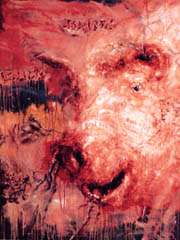 |
| Figure 4. Liu Wei, Pig (detail), 1998, oil on canvas, 120 x 200 cm |
While the “worship of individualism” was seen as most evident in the “hippy” style of Western clothing, demeanor and music, the literary and art spheres were also identified as a negative influence on Chinese values. Xu Dehung, the president of Jiu San Society argued that:
The influence of decadent bourgeois ideology and its corrosion have become more serious, and certain books, magazines, audio tapes and videotapes which spread pornographic, absurb and reactionary materials have become important causes of juvenile delinquency, and liberalization concepts of the bourgeoisie, and all kinds of corrupt ideologies have invaded our society’s ideological, theoretical, literary and art spheres. [32]
As Deng Xiaoping himself remarked, it was those artists and writers who favoured modernist schools and therefore ‘blindly imitate and fanatically pursue foreign culture” at the expense of Chinese traditions. Foreign cultural products were commodifying the local, and were therefore contaminating the spiritual basis of Chinese traditions. Modernism, in other words, was swept into the Western stream of spiritual pollution because it appeared to reflect the worse traits of capitalism, i.e. commercialization, individualism and social irresponsibility. At the Second Plenum of the Twelfth Party Congress, Deng condemned writers and artists who “dwell eagerly on the gloomy and the pessimistic,” of those who are “doing anything for money… indiscriminately givin performances… using low and vulgar form and content to turn an easy profit,” and therefore “pandering to the low tastes of a section of their audiences.” We can already see intimated in this kind of language what will return as the subject of taboo in 2001.
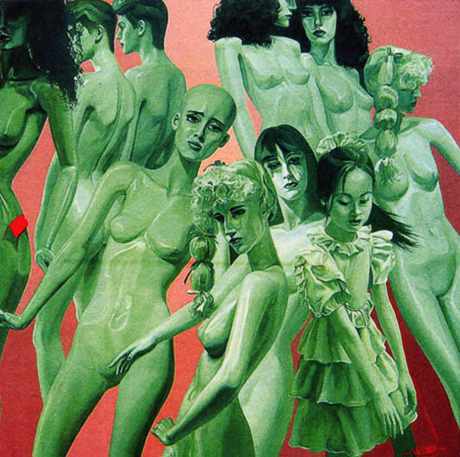 |
| Figure 5. Yu Hong, Vanity Fair, 1992, oil on canvas, 177.2 x 182.9 cm. Courtesy of the artist |
Yet, even before the Twelfth Congress the effect of the emergent campaign against “spiritual pollution” was being felt throughout the literary and artistic circles. In early 1983, the art critic Li Xianting (who would later curate the exhibition Obsession with Harm in 2000) was dismissed from his position as editor of the art monthly Meishu [33] by Deng Liqun on grounds of “spiritual pollution.” [34] The immediate cause was the publication of a two-part article on Chinese abstract ar and calligraphy written by Li Xianting and He Xin, a young academician at the Chinese Academy of Social Sciences. In its pages, they had argued for ^breaking free of realism, championing in particular the model of Western modernism. Li Xianting, who had graduated from the Department of Traditional Chinese Painting of the Central Academy of Fine Arts, supported a dialogue with the West and a level of experimentation ondie grounds that it undermined the government-endorsed aesthetic of realism and values for which it stood. Subsequent to his dismissal from Meishu, Liu Xianting became the ideological foe of his previous collaborator He Xin, and a key figure in the promotion and critical reception of experimental and avant-garde art in China. He Xin, a former Red Guard, on the other hand, became in effect a party ideologue, fiercely attacking the kind of art and literature of the avant-garde experimentalists that had been singled out for condemnation by Deng Liqun. In an article “On Superfluous People,” published in 1985, He Xin drew upon the nineteenth-century Russian literary tradition of the superfluous and the absurd in order to attack certain tendencies within contemporary art and literature. To be “superfluous” (duoyuren) meant to be useless, unproductive, the product of a consumer-oriented culture based on excess. It was not that the aesthetic of the absurd was condemned by the Party. To the contrary, absurdity was sanctioned after 1984 when the Party called for artistic freedom. Rather, what He Xin perceived to be a dangerous trend of cynicism amongst contemporary Chinese authors was to be found in the message conveyed.’ [35] Creating anti-heroes without illusion or hope, they sought to describe the state of ennui experienced by the youth of China. However, for He Xin, this was the work of cultural nihilism, founded on a tradition (especially Freudian and Nietzschian) that was both alien and foreign to China. What is superfluous is linked to anything that can be characterized as Western and therefore non-Chinese. From this perspective, the term superfluous begins to resonate with the Marxist concept of surplus, and specifically to the consumer-oriented culture that Deng’s open-door policy had introduced. Moreover, the concept of surplus value resonated with alienation under capitalism. Reform, in other words, was trans-forming Chinese culture into a spectacle of degradation, undermining the Chinese conception of the human and the individual subject.
It is against this backdrop that John Minford defined the concept of a “ruffian” or “liumang culture” in his article published in the same year as that of He Xin. Minford characterizes liumang as a term for “loafer, hoodlum, hobo, bum, punk.”[36] Rapists, whores, black-marketeers, alienated intellectual, and artists or poets are linked together in what he describes a spectrum that “has its dark satanic end, its long middle band of relentless gray and, shining at the other end, a patch of visionary light. [37] Together, they constitute an “embryonic alternative culture” or “emergent counter-cultural scene,” because in the void left in the wake of the Cultural Revolution, they were thrown back on their own resources which gave them “an authentic sense of identity and culture” and a “radical ) perspective, not only on the present but also on their own traditional culture.” [38] Hence, one of the ironies of the Cultural Revolution is that its failure “left behind [them] a generation capable i of reconciling tradition and a true feeling for modernity.”[39] It is for the writer not an imported / but rather a “new indigenous culture” that, in discovering that many Western sources are from the “ancient Orient,” will bring “spiritual nourishment to the wasteland.” [40]
From this perspective Minford, like Wang Ruoshui and others, see the effects of the Reform movement in a positive light. The opening created by the Reform movement helps to fill the void left by the Cultural Revolution. The question was how to build a theory of emancipation in which indi-vidual freedom and the recuperation of cultural identity could provide the means of overcoming alienation, but without invoking a position of idealist voluntarism. To do so required recognizing that the condition of alienation was as much produced by internalized oppression within the private sphere as by external oppression functioning within the public sphere. One of the problems that remained unresolved throughout the work of these writers was the impact of economic reform and conspicuous consumption. Writers like Wang Ruoshui and Li Zehou had welcomed the new openness and economic reform that surrounded them insofar as it generated a new wave of experimentation and collaborated with commercialization and mass culture. Yet in embracing this openness, they found themselves implicitly endorsing the kind of excesses that He Xin had so trenchantly attacked. The pivotal question remained as to how to foster modernity from within, but without closing the possibility of dialogue and exchange with non-Chinese cultures.
While Minford does not name names, it is Wang Shuo’s satirical stories of crime and love that became quickly associated with the concept of “liumang culture.” By the time of his first novels as, for example The Masters of Mischief (1987), What I am Playing With is Your Heart Beat (1988), and No Man’s Land (1989), the protagonists are rogue characters driven by anti-authoritarianism, uniformity, emotional ennui and rogue humor. In Wang Shuo’s novel What I am Playing With is Your Heart Beat, one of the characters remarks: “Standing in this yard immersed in the sunshine, I am seized with the strong feeling that I have lost something.”41 At the end of Wang Shuo’s novel No Man’s Land-a novel that appeared a few months after the Tian’anmen Square massacre-the inhabitants of Tanzi Alley read out a “letter of appreciation” to the Party Leadership: “Praise be to you, Lord Clear Sky! We the inhabitants of Tanzi Alley thank you for rescuing us from the bitter sea, from the flaming pit, from hell itself.” [42] Midway through the letter they describe themselves as:
… the little people knaves the black haired scum your children grandchildren tufts of grass little dogs and cats a gang of liumangthe cretinous crowds the great masses the hundred surnames and we feel oh-so-lucky extremely moved exceedingly uneasy terribly embarrassed so pleased boundingly enthusiastic very very overwhelmed by our good fortune grateful as all get out tears o’fill our eyes our hearts swell like the seas and we’re utterly and thoroughly lost for words.[43]
While the ironic mimicry of a fawning, docile collective body is evident in this passage, what it also reveals is the emptiness of rhetorical language and the ensuing emptiness of the speaking subject. The punning of “lost for words” suggests a sense of being overwhelmed, yet also vacant or empty-headed. It is this quality that is in part the object of He Xin’s attack on “superfluous people” and that characterizes an emergent strand of liumang art, especially the work of such artists as Fang Lijun. In 1988, Fang Lijun began drawing and painting singular figures or groups of men, staring out from the canvas, often with grimaces, small eyes and bald heads. It was not Minford’s “embryonic counter-culture” that Lijun was depicting so much as the “band of relentless grey.”
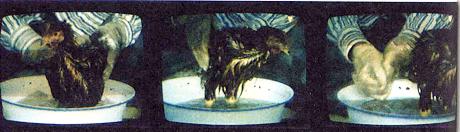 |
| Figure 6. Zhang Peili, video stills from Hygiene No. 3,1991, video. Courtesy of the artist |
An emergent avant-garde
By early 1984, there were signs that the extreme Leftism that had championed the “Anti-Spiritual Pollution” campaign would destroy the possibility of economic reform. The result was its demise and a return to a liberalization of culture. Within this short period of four years, a new avant-garde flourished throughout the country, known as the New Wave or ’85 Movement. This would include not only the early work of artists like Wu Shan Zhuan, Gu Wenda, Xu Bing, and Qiu Zhijie who were engaged in the strategic deconstruction/reconstruction of hegemonic language, but also that of the New Xiamen Dada.44 Based on a participatory aesthetic-hence the reference to Dada-it entailed radical iconoclastic gestures in which the work of art became a form through which to articulate a critique of the State and public culture.
The Fujian coastal city ofXiamen had been designated as one of the four “Special Economic Zones” (SEZ) established as part of the Reform movement in 1979 and reinforced in 1984-1985.[45] In 1986, the New Xiamen Dada burnt all of their own work after an exhibition they had organized themselves. This iconoclastic gesture was accompanied by the statement: “Don’t murder art. Life should not be tranquil.” In this apparent contradiction, art becomes a disruptive social practice that stands in dialectical tension with the acts of destruction against what were perceived as bourgeois cultural artifacts during the Cultural Revolution and in the immediately preceding period of the “Anti-Spiritual Campaign.” On the one hand, these actions convey a sense of purging or censoring of the self and one’s attachment to things viewed as bourgeois commodities. On the other, these actions disrupt the ideological complicity and complacency of those art practices celebrated by the party. To say “don’t murder art” is not then to re-sacralize art so much as to critique the way the party endorsed its reification as an ideological commodity. As Huang Yongping noted in an interview a few years later:
In the social politics of China, art is part of the ideology. Doubting the nature of art and destroying art is to destroy the party system. If one thinks of art as a metaphor for reality, then to change the attitude towards art means planning to change the way of thinking.[46]
The iconoclasm that was characteristic of New Xiamen Dada also appeared in the work of some of its members, notably Huang Yongping who, in the following year, reduced to an indistinguishable pulp in a washing machine A History of Chinese Painting by Wang Bomin and Herbert Read’s A Concise History of Modern Painting (fig. 2). Evelyne Jouanno has commented that the purpose of the artist’s work is not to cleanse culture so much as to “make it dirty” and therefore, does not reflect a modernist nihilism but rather, forms “the will to radically deconstruct and transcend the system and order of discourse that are founded on cultural difference.”47 Seen also within the light of the “Anti-Spiritual Pollution” campaign and the subsequent concern about the “foreign,” Huang Yongping’s gesture reduces to a level of indifference both the foreign and national while, at the same time, by means of a modern form of labour (the washing machine) eradicates the artist’s hand and authorial subjectivity. As with a number of other groups and artists during this brief period, the artist conceived of him or herself as a producer or engineer who intervenes in the production of work that itself is already a readymade. In this manner, the iconoclasm and “decon-structive” character of their artistic practice properly characterizes late modernism within China. Other unofficial avant-garde artists and groups were formed during this period in Harbin, Guangzhou and Hangzhou and Beijing. It includes the Northern Art Group in Harbin in 1985, the Pool Society (Zhang Peili and Geng Jianyi) in Hangzhou (Zhejiang Province) at the end of’ 1985, and the Beijing-based New Measurement Group (Chen Shaoping, Gu Dexin, Wang Luyan) in 1988.48 An intensely analytic engagement with what was called “social reality” characterizes much of the work of each of these groups. Recently for instance, Wang Guangyi-a founding member of the Northern Art Group-remarked that his call in 1988 for the liquidation of humanist enthusiasm was necessary in order to re-establish a “relationship with social reality”49 This commitment to address contemporary “social reality” also characterizes both the Pool Society and New Measurement Group whose art practice entailed a direct engagement within the public sphere, a dematerialization of the object and critique of both authorship and individualism. In seeking to eliminate the art object and erase all signs of individuality this strategy lays the ground-work for a materialist critique based on a rationalist analysis of human behavior.50 In the opening exhibition of the Pool Society, the artists describe their practice as a “brave sacrifice for the future.” [51] One may well ask what the sacrifice is except that of the individual subject, and in effect the work of art and group. This notion of sacrifice will remain an underlying issue in the articulation of later avant-garde and radical practices, and is intimated in the work ofGu Dexin from 1987 in which he shows images of “kneaded beef” in gilded frames or plexi-boxes. Animal (and by implication human) life is reduced to an object of display and of manipulation. Although the avant-garde flourishes in this period of 1985-1989, the campaign against bourgeois liberalization and drive towards a market economy increasingly diminishes the possibilities of its occupying ground within the public sphere. National meetings of artists, scholars, critics are held across the country, coming under much attack by the government and conservative forces within the official art world. In February of 1989, the exhibition China/Avant-Garde held at the National Gallery in Beijing. Curated by Li Xianting and the critic/curator Gao Minglu, it was the first showing of the avant-garde from across the country as it emerged in the 1980s. However it was swiftly dosed when the artist Xiao Lu fired gunshots at the work she produced in collabora-tion with Tang Song. The exhibition was subsequently reopened but then closed again following anonymous bomb threats. In the following months and following Tiananmen Square on June 4th, the ’85 Movement dispersed as artists moved away and groups disbanded. [52]
By the end of the 1980s, Geremie Barme, a historian and acute observer of trends within contem-porary Chinese art, was already having doubts as to the authenticity of a dissenting avant-garde that Minford had described four years earlier. “The end result of Reform,” Barme wrote, “may well be the creation of a new avant-garde art to order: dissent on tap.. .The government’s erratic and hedonistic policies tend to encourage a soul-destroying cynicism in artists of lesser genius. [53] The “patch of visionary light” that Minford had defined as belonging to a post-Mao “embryonic alternative culture” had been displaced, in other words, by a colorless light of cynicism produced by an era of Reform.
It is in this grey band of light we may imagine seeing the spectral appearance of the human and the appearance of Fang Liquns paintings. Belonging to the third generation of post-Cultural Revolution artists, Lijun grew up in an intense transitional moment in which the New Era came to a close with the violence of Tiananmen Square and the closure of the China Avant-Garde exhibition. On finishing his first series of paintings, the artist remarked “We would rather be described as painters of loss, ennui and crisis or as rogues or as the bewildered, but we will never again be deceived.”‘ [54]
In gaining currency in the immediate post-1989 period, the social base and significance of “liumang culture” was transformed. It no longer represented a nascent or “embryonic counter-culture” but was redefined to refer to both the government and protesters alike, one describing the actions of the army, the other of the people. In an article “My Perplexities and Concerns,” He Xin associates the iconoclastic intellectuals with the Red Guard, an idea that repeats Deng Xiaoping’s earlier view. For He Xin, “the young agitators for political reform in China are rabble-rousers who are carrying on from where the Gang of Four left off, their real aim being to overthrow the Party and eliminate ‘capitalist readers’.[55] While, on the other hand, Zuo Shula wrote of Wang Shuo: “So and so’s father was penalized for hooliganism and still they let him have a position in the leader-ship.” [56] It is to this that Wang Nanming was referring when remarking on the “tradition of Mao’s ruffian politics: a type of politics characterized by its use of power to violate rights.[57] Wang Shuo’s hooligan reveals itself as a product of the duplicity of the elite class and leadership. There is no moral authority and the oppressed and oppressors begin to mirror one another.
For critics, especially Li Xianting, the significance of “cynical realism” (a phrase he coined at the time to describe the paintings of Fang Lijun and other artists like him)-was somewhat different. It belonged to what he defined as a long radical literary and artistic tradition within China.[58] Placed within this historical context, the author argues for viewing the figure of the rogue as the enemy of authoritarianism, whose cynicism and humor constituted a form of “spiritual self-liberation and not merely signs of the Post ’89 period.[59] With broad strokes, Li Xianting seeks to reclaim a Chinese transgressive or avant-garde tradition that includes writers from the Wei-Jin period (220-420) and the Yuan and Ming dynasties through to writers of the May Fourth Movement (1919), in particular Zhou Zuoren and his brother Lu Xun.[60]
Written in 1996, the author’s allusion to the May Fourth Movement retrieves a key point of reference in the debates of the 1980s. Specifically, it recuperates the movement as part of a Chinese tradition-as distinct from being Eurocentric-and therefore defends the contemporary work as belonging to a Chinese tradition of modernity. Moreover, reference to Zhou Zuoren invokes an author committed to re-establishing the validity of individualism as the key to reinstating the humanist subject. In referring to Lu Xun’s famous novel Diary of a Madman (1918), Li Xianting also recalls a novel that was so strongly identified with the May Fourth Movement, but also received extraordinary literary attention in the 1980s. As Xiaobing Tang notes, the novel dramatized “the conflicts between conformity and individuality, between doctrine and interpretation,” and for some of those writers, it meant the “difficult task of reclaiming a radical tradition of transgressive politics.”[61] Such politics belonged to the modernist project of representing the struggle of lower classes to emancipate themselves from oppression. Similarly, Xianting’s reference to the famous fourteenth century epic novel The Water Margin invokes a text whose interpretation became a key site of ideological difference and struggle, especially during the Cultural Revolution and the Gang of Four. The figure of the rebel and bandit hero as represented in the novel becomes identified with the ordinary citizen and literati respectively. In the context of the twentieth century, from the Republican Revolution through to the Communist era and after, it was viewed as either a faithful rendering of peasant consciousness and rebellion or as a literary and reformist account of popular rebellion. [62] In 1991, the critic Mu Gong argued that “hooligan literature is an aristocratic genre written within the mental configuration plebian culture.[63] To speak then of of liumang culture” was to refer to the fetishization of the popular by intellectuals, writers and artists as a way of reclaiming an existing tradition of anti-authoritarian rebelliousness, as opposed to the State-sponsored ruffian or violent “hooligan” culture. What was at issue was the leveling of privilege so that the elite is forced to jostle alongside the plebian working class. In this sense “hooligan” culture’s “unproductive and totally consumptive” lifestyle strikes a sympathetic cord. [64]
By 1992, the strengthening of China’s commitment to market reform had had a radical impact on the way in which the liumang was being viewed. They had become the “last proletarians in the new society” or alternatively, the “by-products of China’s market economy.[65] Or, as Geremie Barme also noted at the time, artists were “exploiting and commodifying images of their world allowing them to take part in the “international process of display and consumption.[66] Following this line of interpretation, the cultural historian Jing Wang has more recently observed, “Commercialism could turn yesterday’s cutting edge into tomorrow’s museum piece.” [67] In an editorial note to a translation of a Wang Shuo story, Barme writes “Wang and his fellows have helped turn the rowdy youth culture of the Cultural Revolution into the ethos of the Reform age. Many of them have also made a lot of money’s out of China’s further social and cultural degradation.” [68] Ironically, the critics who had identified cynicism as characteristic of the liumang undergo what may be called an effect of transference so that the authors themselves begin to experience the very cynicism they have observed in others.
In a manner consistent with Marx’s critique of the processes of reification and religious fetishism, the promise of liumang culture” that Minford had identified as bringing “spiritual nourishment to the wasteland” is achieved through the fetishization of art as commodity. What is striking in this respect is how the artists associated with “liumang culture” became so marketable, as if the very energies that had characterized them as a rebellious alternative culture and as “superfluous” by-product of Western values were harnessed and converted into cultural surplus by the State, and hence became valuable export. Consequently, we find that the liumang aesthetic gains the support of the foreign experts and the international art market as a sign of the liberalization of Chinese culture by the State. This view has been strongly argued by Hou Hanru, who writes that the “cynical realism” of these liumang artists is a form of “ideological centrism.” It is in his words a “compromise between the avant-garde and the official ideology” insofar as their “languages are popular or mannerist adaptations of the academic conventions” that “mingle the popular discontentments of political and everyday life with the market values.” This position represents a cultural pragmatism, whereby both camps consciously identify with the values of the market system. As Hou Hanru points out “on the one hand, identification with the market values and their promotion can become an ingenious means of preserving its own power and interests in the time of ‘opening doors and reforms’ while, on the other hand, the market values seem to embody the possibility of freedom of expression and, especially, the guarantee of their commercial interests.[69]
Crucial to Hou Hanru’s analysis is the suggestion of complicity between the State and liumang generation vis-a-vis the market, i.e. that pragmatism itself is a form of cynical realism.[70] Moreover, his remarks serve as a resignification as to what He Xin had referred to as the “superfluous man” in 1985. For while concurring with the view that the spectacle of degradation has appeared as in part a consequence of a consumer- oriented culture, Hou Hanru turns it back to incorporate official Chinese ideology rather than simply the result of what is labeled as Western influence. What is however, less remarked upon but of equal importance, is that the market values “embody the possibility of personal freedom.”
The counter-cultural impulse of the “liumang culture” finds its liberation or autonomy in the marketplace of conspicuous consumption. It is within this framework that we may locate the sudden appearance and popularity of both “Gaudy Art” and “Political Pop,” as stylistic phenomena that Li Xianting defined early on as belonging to the tendency of cynical realism as it emerged within the Reform era: “intuitively responding to the ‘get-rich-quick’ attitude of the dreams and realities of peasants, brought about or emerging to of the consequences of Western consumer culture in China. [71] While the paintings of Wang Guangyi, Wang Ziwei, and Qi Zhilong have been lumped together, it would be important to distinguish them retrospectively as operating within very different critical modalities (fig. 3). Doubtless, some of the work does entail a parodic recycling of political icons, consumer logos and celluloid stars, as well as advertising commercial symbols. By virtue of their repetition and reification as art objects, they succeed in emptying out meaning, and its seriality eradicates all signs of subjectivity for the glamorous sheen of mass-produced objects. The critique of the auratic status of art and authorship that had characterized the participatory aesthetic of the avant-garde groups in the second half of the 1980s has been appropriated in order to facilitate the entry of contemporary art into the nascent culture industry. In this sense, the work of these artists belongs to the tendency of “Cynical Realism” because the public sphere is no longer a site of radical engagement but that of the alienated subject. “Gaudy Art” and “Political Pop” offer the spectacle of consumption as an emancipatory antidote to the condition of alienation.
As a counterpart to this body of work, the paintings of Fang Lijun offer no such antidote. The sense of ennui and boredom that characterizes the work produced in the early 1990s, offer little by way of comfort to the mundane reality of everyday life or alienation. The scene has been emptied out, devoid of mesmerizing icons. Likewise, Gao Minglu, in his reassessment of this period, has suggested that the paintings present “a neutralizing attitude and a new realistic technique that duplicated the referent, not to represent but rather to project it into a decontextualized frozen moment […] by this means, then ” the real, original referent becomes the unreal.[72] The empty skies and landscapes mean that there are no longer specific symbolic markers of the Cultural Revolution or of collective Utopia. For Li Xianting, the shaved head in the paintings of Fang Lijun become a lexical signifier, “a rogue’s shaved head with a meaningless expression enabled a form of non-meaning to dissolve a system of meaning associated with rebellion and satire.” The images are without context, an emptying out of history as if collective memory has been erased, a condition of amnesia that turns away from the past, but equally redefines symbolically the contemporary human as primarily having to do with the self, as distinct from the collective. There is now nothing to which to refer. It has disappeared, both in real terms, and symbolically as a site of value. Yet nor is there an inferiority-a rogue’s life is vacuous, empty, detached. It becomes at best post-political, post-historical. The very idea of an emancipated subject is no longer possible, by means of neither the social structure nor individual subjectivity As Xiaobing Tang notes in writing on experimental fiction of this period, the protagonist is “without a privileged position, having no control over events, and even less control over the cease-less movement of language itself. [73] Following Raymond Williams’ description of the modernist novel as a “narrative of unsettlement, homelessness, solitude and impoverished independence,” Tang argues that while this characterizes the protagonist of both modernism and fiction today, there is now a “foreclosure of anxiety” whereby the intensity of the narrative is “circumscribed and understood.[74] This foreclosure produces a sense of relief, but in so doing depoliticizes the subject in a manner that aligns it with consumer capitalism and distinguishes it from the residual modernism of an earlier period. It is a “postmodernist sensibility of residual modernism [in which] the unconscious of residual modernism strives for such’masochistic relief’. [75] In other words, the kind of transgressive politics that had characterized the May Fourth Movement has all but been emptied out of its oppositionality, reinscribed within the bounds of inferiority rather than within a larger social domain.
De/regulating the body
Following the events surrounding Tian’anmen Square in 1989, the government restrengthens its purge on what it called “bourgeois liberalization.” The humanism espoused byWang Ruoshui, Li Zehou, and Liu Zaifu, amongst others, in the 1980s, came under attack, and they were criticized as belonging to an elite who had been responsible for the turmoil of Tian’anmen Square.[76]
Commenting on the era of the 1980s and work of Wang Ruoshui, Jing Wang has pointed out the ways in which the issue of alienation overshadowed the question of emancipatory subjectivity, i.e. subjectivity as a means of emancipation.[77] Jing Wang acknowledges the difficulty of thinking through these issues in a manner that was not couched within a broader cultural context of the nation and of China’s relation to the West. That is, de-alienation was not conceived of as a subjective practice within the private sphere, but rather as a means to identify both areas for party reform, and, more importantly, those elements that reflected the influence of alienating bourgeois values that needed eradicating. What was left out of the picture was the way in which emancipation had to begin with the effects of internalized oppression. Moreover, as Jing Wang points out the “Anti-Spiritual Pollution” campaign unleashed a “haunting spectacle of the perpetuation of oppression by the oppressed themselves.”78 The author continues: “As long as the Chinese fail to acknowledge that ‘the patterns of thought and action inculcated through the experience of oppression take on a substantiality and a life of their own; alienation will be reproduced from within at any suggestive call for the return of the oppressed.”[79]
In the early 1990s Liu Wei begins his series You like Pork? with its images of semi-naked women grotesquely displaying themselves, surrounded, by an overall field of images of slices of meat or rotting flesh (fig. 4). While the artist has commented that they are paintings of trash, it is the confrontational nature of the image that seems most startling to a viewer. It is no longer the iconic image of Mao who stares out from the canvas inviting worship, but the figure of a woman. Man is reduced to a voyeuristic plaything of the icon, woman to a fetish thing, and human nature to a chaotic libidinous frenzy.
From birth to death, we’re all one person, with no variation in kind, except perhaps that of our sex, that’s all. When he (or she) is born into this world, he’s like a peeled egg, hot and steamy and very fresh, even so, like the rest of us, he still eats, drinks, pisses, shits and sleeps.” [80]
It is this kind of radical disturbance of the subject position and reduction of being human that will lead the artist to later produce a series of paintings Who am I? (2000) in which the male subject is defaced. Cultural consumption is turned into a vulgar spectacle of China debasing itself.
There is also a degree to which the ethos of consumerism and youth culture within China begin to produce a critical dis-engagement from its effects. In Yu Hong’s painting Vanity Fair (1992), the artist portrays a small girl amidst a group of unclothed mannequins (fig. 5). With all the characteristics of Western stereotypes, the image suggests the imposition of foreign cultural values imported during the period of consumerism in China. Emancipation finds its place within the realm of consumption and women become part of an economy of the spectacle, of desire. Yu Hong’s painting suggests the ways in which contemporary China was experiencing a powerful sense of dehumanization, and a de-realization of the everyday world in which citizens found themselves. This heightened sense of superfluousness becomes characteristic of the period and is found in the work of Yu Hong’s contemporaries, sometimes associated with the liumang. In 1991, a young group of artists, amongst them Yu Hong, held an exhibition called New Generation, which was one of the first major exhibitions to be held after June 4th. Shown at the Museum of Chinese History, it marked the emergence of a new realist style that therefore distinguished itself from the academic style favored by the government, as well as the avant-garde work shown in the cancelled show of 1989 China/Avant-Garde. Wu Hung, writing on the work of Yu Hong and Liu Xiaodong, has noted that their paintings were of “mundane scenes of daily life” in which the “figures .. .are always engaged in trivial matters and often seem at a loss,” a loss that expresses a certain attachment and detachment from reality.”[81]
The sense of alienation and dislocation from the real becomes increasingly prominent in the art of the 1990s. Scenes of waste and disintegration, of abandonment and decay become powerful vectors for capturing a sense of powerlessness, a kind of “negative freedom” where the image of “total abandon” is not easily filled by conspicuous consumption. The consequences are an economy of excess, corruption and unproductive expenditure that veils a society in which not everyone can participate in the emergent leisure culture but which, to the contrary, leads to greater impoverish-ment and suffering by those unable to participate in such an economy.
Within this broad social environment two interrelated but distinct artistic tendencies emerge. The first of these two tendencies represents a continuation of the pre-1989 avant-garde initiatives and is exemplified in the work of the New Analysts group and the work of artists who had been associated with the Pool Society, especially Zhang Peili, (one of its founding members). His early work represents an exploration of relations between pollution and control, especially his video piece Hygiene No. 3 (1991) in which he is filmed repeatedly washing a chicken to the point that the animal is reduced to a condition of total passivity (fig. 6). The artist becomes the master to the slave as the chicken, whose image is likened by many to the shape of China, is reduced to little more than a docile object. The second tendency appears through performance-based work based on and around the body, a tendency that appears most forcibly in the early 1990s.
Both tendencies seek in different ways to address issues concerning social values and to implicitly critique the fetishization of the material object and condition of alienation. [82] In a manner that marks their opposition to the “Gaudy Art” and “Political Pop” work of the same period, these two tendencies distance themselves from the fetishization of the art as commodity, focusing instead on the regulation and de-regulation of everyday life. As Hou Hanru writes, “it is a strategy to expose the absurdity of the everyday under ideologically oriented regulations as the dominant force in social and private life.” [83] In fact, this increasing state of deregulation contributes to an undermining of the attempt by certain avant-garde groups to base their work on a rationally based inquiry into the conditions governing everyday life.
The idea of regulation and de-regulation of everyday life takes on a different valence within the second tendency. Questions of taboo, perversion and violence begin to appear as symptomatic of prohibition and over-regulated everyday life but equally, the unprecedented appearance of deregu-lated desire within a consumer-oriented economy. For while the slogan of Reform: “To get rich is glorious” is the basis on which a fetishism of the commodity is founded, it is also the enabling factor of access to other forms of fetishistic behavior or corruption; i.e. pornography, gambling, smuggling, prostitution, etc. It is precisely this domain that the State identifies as “spiritual pollution” and seeks to regulate, even though by marking it as taboo its illicit character will become all the more the object of fascination. It therefore functions to re-inscribe the acceptable limits and values within which contemporary art must perform. Fetishism becomes the object of a driving desire to achieve change and fulfillment of individual needs and social goals.
Within this context, the emergence of performance art in this era of reform is not coincidental, but rather functions to incorporate and corporalize the fetish power of the object. To act upon the body directly, to turn it into a fetish object, represented a libidinal investment in the object as a form of emancipation of the subject from alienation and a sense of impotence in their control over their own actions. Under Mao, the Chinese people had been instilled with the belief that change and the prospect of a rosy future was only possible through an embrace of the collective values propagated by the party. The writings of those who had engaged with issues of humanism and alienation in the 1980s had depoliticized the body, advocating an independent, autonomous and self-regulating human subject that could demand recognition of both dignity and rights. However, this detachment from society was for some no longer a viable option in a post-Tian’anmen era. Moreover, it was also undermined by the appeal of a consumer culture in which individual subjectivity was now championed by the party. And yet, we should also observe here that this led not only to a continuing representation within the experimental and avant-garde art of the disastrous effects of collectivization but also, to the appropriation of an inherently problem-atic model of the cult of the individual body albeit, in this case, the cult of Mao Zedong and sacralization of the body of the leader.
I will mention in this context two works – Weeping Angels of 1993 by Zhang Huan and Temptation of 1994 by Zhan Wang – which, in distinct ways, capture the complexity of these issues and suggest how the humanist perspective that had characterized the New Era period had been hollowed out of its Utopian faith in the universal progress of humanity.
The work of Zhang Huan is a sculptural installation composed of a row of large upright cases and a string of hanging baby dolls. This followed his Masters thesis for which he produced Weeping Angel (1993) – a suspended plastic child on a wall covered in black felt. Authorities at Academy of Fine Arts, Beijing, threatened to close the exhibition if he did not write a formal apology. He did so, but the exhibition was nonetheless closed (fig. 7).” With reference to that time, Zhang Huan later wrote that:
Maybe it was because of the poor countryside in Henan where I grew up, I got hepatitis-because I had nothing to eat. There were many deaths and funerals. I can never forget the funerals of my grand-mother and other relatives. Maybe it was also because of my personal life in Beijing. You could not keep your child when your girlfriend was pregnant…Girls of my generation have to go through many abortions…Many unborn babies died. This is the situation of the Nineties.” [85]
In 1994, Zhang Huan made his first public performance work 12 Square Meters in which the artist sits on a public toilet, his body covered in honey and fish oil. Flies quickly swarm all over him. He then submerges himself in a polluted river close by. In the same year, he performed 65 Kilograms in which he suspended himself ten feet above the ground, forcing blood from a wound to his neck to drip into a metal bowl placed directly below him on a stove.8′ It is no longer the scene of tough bravado, or inversely of apathy and inertia, where subjectivity was able to construct for itself a dimension of inferiority, however much it was filled by a sense of ennui and disillusion. Rather, an economy of surplus produces a sacrificial economy in which heroism has been dis-placed by self-destruction and violence. In this regard, we should mention Yan Lei’s exhibition Invasion held in the following year. In it the artist showed videos and photographs of a sow waiting for slaughter and himself as the object of violence. [87]
These performances recall a passage from Wang Shuo’s novel No Man’s Land (translated as “What-ever you do, don’t treat me as human”) in which the anti-hero Tang Yuanbao remarks “From now on, I’m no longer human…not an ordinary person.” In the martial arts competition held between them is an “art of endurance,” who can tolerate the most enduring and humiliating treatment. The test includes being bound and tied. Tang is compressed into a smaller shape than any other, he drinks the piss of someone who rides him like a horse, he submerges himself in water whose temperature is lowered to freezing point, and performs his own trial of endurance by hit-ting his own face until it is swollen and purple. The others put cats into their pants, use their teeth to pull a rope connected to a lorry and place their heads into a gaping lion’s maw and tickle it. [88]
Comparatively, Zhan Wang’s sculptural installations confront more directly the process of dehumanization, a process in which the image of death becomes the uncanny specter of human life. Temptation (1994) is composed of a group ofemptied-out Mao suits, molded to look like figures and placed on a mound of earth, or suspended from scaffolding (fig. 8). In an interview, he commented that it was an image of cicadas transforming themselves, discarding their skins in order to transcend the mortality of their body. Hung Wu has observed that it corresponds with the ancient Chinese notion of the cicada as symbol of immortality, which can be found in the carvings made for tombs. However, this correspondence may also function metaphorically whereby the hollow shells allude to contemporary China. Against the classicism of the human figure expected of the Academy the artist creates hollowed out figures whose distorted postures suggest both an external and internal wound. Hence, we may better understand the suggestiveness of the artist’s words when he comments, “the new body is nowhere to be seen. We have no idea what it has become-either dead or reborn, in heaven or hell.” [89] This reading is strengthened by Zhan Wang’s dramatic elaboration of the work in the same year. Re-titled Temptation: An Outdoor Experiment, he placed the hollowed-out figures in the ruins of an abandoned and partially destroyed building in Beijing (fig. 9). [90] The shift between these two works provides an intensely telescoped view of on the one hand, a failed collective enthusiasm for the Cultural Revolution (symbolized by the Red Guards) and on the other, intimations of a future in which collective urbanization offers a dismal alternative. Not only does the hollowed out form capture the impoverishment of the spirit and body, but the utter superHuousness of its form and therefore existence.
From this perspective, the artistic experiments of both Zhang Huan and Zhan Wang, as it emerged in the early 1990s, should be seen as a critical engagement with what may be viewed as the super-fluousness of human life in China. Moreover, a comparison between the two artists throws into sharp relief the subject of masculinity and, in turn, a much larger history of how masculinity was shaped by and articulated notions of liberation, emancipation, revolt or revolution. Reading back on this history, the image of the bandit or rebel in The Water Margin, the Red Guard, the liumang figure and the kind of performance work that dominates the 1990s through to recent times, is each informed by the subject of gender as critical to self-definition and the cultural values. If their work resonates with performance art from outside of China, it does so not to emulate but to find ways to create a critical practice that is contemporaneous to issues confronting those individuals and society. In this aspect, one can mention artists like Yuan Dongping, whose powerful photographic series from 1989 of patients in a hospital for mental “diseases” or “disorder” expose what the artist describes as the “inhuman conditions of the asylum” and an environment in which individuals are treated as human waste. [91]
In these terms, the artistic practice of these artists turns the tables on He Xin’s attack on the “superfluous” in contemporary Chinese literature as symptomatic of Western decadence and cultural nihilism. It now becomes evident that the Reform era unleashed and led, in turn, to the kind of degradation of human life and perverse obsession with mortality and death witnessed in contemporary Chinese art today. [92] The “pornographic” then constitutes not so much a matter of the debasement and exploitation of others as much as a symbolic expression of a culture of conspicuous consumption and libidinal investment. The performances in which the human or animal is the subject of degradation or in which there is fascination with the corporality of the body and death cannot be understood as the consequence of Western values, or more simply an imported stylistic influence that therefore delegitimate its local significance and value.
In contradistinction, we might say that while American and European art has held up a certain model to Chinese culture, Chinese artists recognize and rearticulate that model within their own terms and as a belated response to the recent traumatic history of modern China. This belatedness is symptomatic of a non-synchronic development of China since the collapse of the New Era, and with it humanism and modernism at the beginning of the 1990s. In point of fact, it marks the disruptive transitional movement into a post-socialist economy and a postmodernist China. Such work represents as much a “return of the oppressed” as the repressed for a society whose government exerts on the one hand an extreme moral authority and on the other, expounds the pursuit of material well-being through the embrace of a consumer-oriented culture even if this implies a depoliticized and “manufactured consensus” that is orchestrated by the State. [93]
The project of emancipation leads to what may viewed as the ethical extreme, that is, to its exposure to a symbolic dehumanization of the human. In so doing, what appears to be at stake in this body of work, and in the precedents that constitute its historical formation, is that what it means to be human remains more than ever urgently at risk.
Notes
A portion of this essay was delivered at the conference “Chinese Contemporary vs. Contemporary Chinese” held at the British Museum, London in April 2002.1 would like to thank Wu Hung, Sasha Su-Ling Welland and Britta Erickson (or their reading of the essay and suggestions offered for its improvement).
[1] lan Johnson, “New Chinese Art: Revolting,” The Wall Street Journal {5 May, 1999): 20.
[2] The concept of both the West and China as undifferentiated ideological entities means that they remain, for the most part, unproblematic points of reference by commentators and artists alike.
[3] Karen Smith, “Contagious Desire,” Art Asia Pacific 31 (2001}: 56.
[4] Ibid.. 56.
[5] Ibid.,54.
[6] Ibid.. 54.
[7] Ibid.,53,56.
[8] Ibid., 53.
[9] That being said, I wish to acknowledge the importance of the author’s article, with which there is much to agree and which formed, in part, the impetus (or my essay.
[10] Wang Nanming, “How to Deal with Rights-A Criticism of the Violent Trend in Chinese Contemporary Art,” Chinese-Art.com 4.2 (2001): 2.
[11] Ibid.
[12] John Minford, “Picking up the Pieces,” Far Eastern Economic Review (8 August, 1985); 30.
[13] Huang Du, Post Material (Beijing: Red Gate Gallery, 2000), 14.
[14] Zhu Qi, “Reviving:Tne Alienated Image of Red Paradise,” Time of Reviving (Chengdu: Upriver Gallery, 2000), unpaginated.
[15] Ibid., Chen Jiagang, Preface. “Smith, “Contagious Desire,” 57,
[17] Cited in Gary Jones, “Art: Hard to Swallow,” The Independent (27 February, 2000): 18.
[18] Wu Meichun, “Alien bodies and Delusion” in Wu Meicnun and Qiu Zhijie, Hou gan xing = Post-Sense Sensibility (Beijing: [s.n.], 1999), 1.
See also the excellent documentation by Wu Hung in his book Exhibiting Experimental Art in China (Chicago: University of Chicago, 2000).
[19] See the citation of the Chinese critic Pi Li, The Wall Street Journal (5 May, 1999): 20.
[20] lan Johnson, “New Chinese Art: Revolting,” 20.
[21] Sun Yuan cited in Gary Jones, The Independent (27 February, 2000): 19.
[22] Deng Xiaoping, People’s Daily (19 July, 1983).
[23] With the fear that foreign investment would suffer as a result of the anti-Western sentiments, the campaign quickly subsided within five months.
[24] Portions of Wang Ruoshui’s text are translated in Inside Mainland China 5/6 (June 1983): 7-8. The “Mao cult” or “cult of the leader” was parodied and satirized by painters and writers in the late 1980s.
[25] Wang Ruoshui, “in Defense o1 Humanism” cited in Jing Wang, High Culture Fever, Berkeley: University of of California Press, 1996), 26.
[26] Wei Lien Chong, “Combining Marx with Kant; The Philosophical Anthropology of Li Zehou,” Philosophy East and West 49.2 (April 1999): 121.
[27Xiaobing Tang, “The Function of New Theory in Politics, Ideology and Literary Discourse” in Modern China, eds. Liu Kang and Xiaobing Tang
(Durham: Duke University Press, 1993), 284.
[28] Liu Kang, “Subjectivity, Marxism and Culture Theory in China,” Social Text 31/32 (1993): 133.
[29] In early 1984, Wang Ruoshui was dismissed from his post at the People’s Daily, then reinstated later that year, following the waning of the “Anti-Spiritual Pollution” campaign.
[30] See transcript of Deng Xiaoping’s speech at the Second Plenum on 12 October, 1983, published in Issues and Studies 20.4
(April 1984): 99-111.
[31] See Thomas B. Gold, “Just in Time! China Battles Spiritual Pollution on the Eve of 1984,” Asian Survey 34.9 (September 1984): 957.
[32] Ibid., 965.
[33] Meishu (1983): 4-9 and 5 (1983):16-19. See also Geremie Barme, Translator’s Introduction to He Xin’s “A Word of Advice to the Politburo,” Australian Journal of Chinese Affairs 23 (January 1990)-. 51.
[34] Karen Smith, “Contagious Desire,” 53. By 1985 Li Xiantjng joined with the journal Fine Arts in China (Zhongguo meishubao) supporting new emergent artists, such as the Stars group that formed in 1979.
[35] Amongst the authors who became the target of his attack were Xu Xing and Liu Suola. See an extract translated in New Ghosts Old Dreams eds. Geremie Barme and Linda Jaivin (New York: Random House, 1992), 260-264. He Xin also published in the same year an article “Absurdity and Superfluous People in Contemporary Literature,” Dushu 11 (1985): 3-13.
[36] John Minford, “Picking up the Pieces,” 30.
[37] Ibid.
[38] Ibid., 30-31.
[38] Ibid., 30.
[39] Ibid., 31-32.
[41] Jing Wang, High Culture Fever, 272.
[42] Wang Shuo, “MaoSpeak,” Chinese Sociology and Anthropology 28.1 (Fall 1995); 96-98.
[43] Ibid.
[44] This body of work by Xu Bing, Wu Shan Zhuan, Gu Wenda and Qiu Zhijie has been written on extensively most importantly by Wu Hung “Ruins, Fragmentation and the Chinese Modern/Postmodern” and Norman Bryson, “The Post Ideological Avant-Garde,” in Inside Out (Berkeley: University of California Press, 1998), and more specifically on Xu Bing in a marvelous piece of analysis by Britta Erickson Words without Meaning, Meaning without Words: The Art of Xu Bing (Seattle and London: University of Washington Press, 2001). See also my essay “Forgetting the Memory of the Word: Writing Lessons in Contemporary Chinese Art” in Re/Trace: Dialogues, eds, Jagjit Chuhan, Angela Dimitrakaki, and Emma Thomas (Liverpool: John Moores University, 2001), 62-69,
[45] Various leaders had toured Xiamen, and while variously supporting the concept of the SEZ had also voiced concern that such cities especially those like Xiamen situated directly across the straits from Taiwan, were vulnerable to being corrupted by foreign investment The party historian and theoretician Hu Qiaomu, who voiced similar concerns in his tour of Xiamen in 1985, was also at this time waging a theoretical debate with the concept of social humanism as advanced by Wang Ruoshui.
[46] Interview with Jean-Hubert Martin, Resistance (Tokyo: Watari-um: The Watari Museum of Contemporary Art), 1992.
[47] Evelyne Jouanno, “According to the Potential of the situation,” Huang Yongping (Amsterdam: De Appel, 1998). 40.
[48] The Pool Society ended in 1989 and the New Measurement Group (also known as the New Analysts group) dissolved in 1995.
[49] See my “Interview with Wang Guangyi on the Socialist Visual Experience,” in Wang Guangy/(Hong Kong: TimezoneS). 27-28. –
[50] See especially Hou Hanru’s excellent essay in “Somewhere between Utopia and chaos” in Another Long March, ed. Chris Driessen and Heidi van Mierio (Breda: Fundament Foundation 1997), 54-91. See also Gao Minglu, “From Elite to Small Man,” in Inside/Out- New Chinese Art (Berkeley: University of California Press, 1999), 158ff.
[51] Gao Minglu, “From Elite to Small Man,” 165, fn.5.
[52] Huang Yongping moved to Europe in 1989. Other artists like Gu Wenda left in 1988, while Xu Bing left in 1990.
[53] Geremie Barme, “Arriere-pensee on an Avant-Garde: The Stars in Retrospect,” The Stars: 10 Years (Hong Kong: Hanart TZ Gallery, 1989).
[54] The source of these paintings has been linked to the work of Geng Jianyi and Zhang Peili, amongst others, and the Pool Society that produced paintings under the rubric of “grey humour” as opposed to “red humour.” See Gao Minglu, “From Elite to Small Man,” 156.
[55] Published in Xuexi Yuekan 12 (1988): 34-38. Cited in Geremie Barme, Translator’s Introduction to He Xin’s “A Word of Advice to the Politburo,” 55-56.
[56] Cited in Geremie Barme, “Wang Shuo and Liumang (‘Hooligan’) Culture,” The Australian Journal of Chinese Affairs 28 (July 1992): 31.
[57] Wang Nanming, Chinese-art.com 4.2 (2001).
[58] Li Xianting, Fang Lijun: Human Images in An Uncertain Age (Tokyo; Japan Foundation Forum, 1996), unpaginated.
[59] Ibid.
[60] lt should be noted here that the May Fourth Movement became the subject of successive ideological claims, so that an artist like Xu Bing could be accused of opposing its tradition on the grounds that he had succumbed to the “spell of foreign thoughts.” See Britta Erickson Words without Meaning, Meaning without Words: The Art of Xu Bing, 41.
[61] Xiaobing Tang, Chinese Modern (Durham and London: Duke University Press, 2000), 63.
[62] “More recently, the writer and political prisoner Wei Jingsheng refers to the epic as a model for different kinds of popular rebellion in China’s modern historyaeheroic tales that signify the historical continuity of the political struggle of Chinese people’s desire for recognition. J. Fitzgerald, “Continuity and Discontinuity: The case of ‘The Water Margin’ Mythology,” Modern China 12.3 (July 1986)’ 361 -400 and “China and Quest for Dignity,” ibid., 58.
[63] Mu Gong, “Wang Shuo: Zhishi fenzi wenhua de bishizhe,” Zhongshan 1 (1991): 152: cited in Wang, High Culture Fever. 269.
[64] This reading is dependent on Jing Wang’s wonderful chapter of High Culture Fever entitled “Wang Shuo: Pop Goes the Culture,” 261 -286.
[65] Ibid., 269.
[66] Geremie Barme, “Exploit, Export, Expropriate: Artful Marketing from China 1989-93 ” China’s NewArt Post-1989 (Hong Kong: Hanart TZ Gallery 1993), LI.
[67] Wang, High Culture Fever, 116.
[68] Geremie Barme, editorial note to Wang Shuo, “MaoSpeak,” 96.
[69] Hou Hanru, “Somewhere between Utopia and chaos,” in Another Long March, ed. Chris Driessen and Heidi van Mierio (Breda: Fundament Foundation 1997), 67. [70] This kind of cynicism is not uncommon within Communist countries and manifested itself most clearly in Cuba during the second half of the 1980s, whereby cultural export served to improve the image of Cuba and potentially attract tourism, and thus foreign currency and goodwill However, it was abruptly ended when it appeared that the government was not able to maintain control over their vested interests. Subsequently, those artists having established an export market, exported themselves into permanent exile, only to find of course that the marketplace had moved on, less interested because they no longer represented an “exotic” import.
[71] For an extended discussion of these tendencies see Li Xianting, “Some More Thoughts on the Raison d’Etre of Gaudv Art” reprinted at Chinese-Art.com 2.2 (1999).
[72] Gao Minglu, “From Elite to Small Man,” 156. This essay was published in the exhibition Inside/Out for which Gao Minglu was guest curator. It opened in the U.S. ten years after the now landmark exhibition China/Avant-Garde in 1989 which he co-curated with Li Xianting.
[73] Tang, Chinese Modern, 199.
[74] Ibid.
[75] Ibid., 200. What is interesting to note is the author’s introduction of the word “masochistic” into his text. The word “masochistic” does not appear in the article version published seven years earlier in 1993.
[76] In the months following June 1989, Li Zehou’s writings all but disappeared from view and he was unable to lecture or publish. See Lin Min, “The Search for Modernity: Chinese Intellectual Discourse and Li Zehou,” China Quarterly 132 (December 1993): 991. Liu Zaifu was dismissed as editor of the leading journal Literary Review, which had published articles critical of Mao’s policy on cultural production.
[77] Wang. High Culture Fever, 19ff.
[78] Ibid., 19.
[79] Ibid., Here the author is also citing a passage from Emancipation and Consciousness by Erica Shrerover-Marcuse (Oxford: Basil Blackwell, 1986), 126
[80] Cited by Li Xianting from “A Painterly Gift,” and reproduced in Made by Chinese (Paris: Galerie Ennrico Navarra, 2001), 82.
[81] Wu Hung, Transience (Chicago: University of Chicago Press, 1999), 144-147.
[82] In briefly addressing the issue of the fetish, I am indebted to the work of William Pietz. See Fetishism as Cultural Discourse, eds. Emily Apter and William Pietz (Cornel): Cornell University Press, 1993).
[83] Hou Hanru, “Towards an ‘Un-official Art’,” Third Text 34 (Spring 196): 50.
[84] Wu Hung, Transience (Chicago: University of Chicago Press, 1999), 199.
[85] Ibid., 105
[86] For a longer discussion of Zhang Huan’s early work see my essay: “Becoming Posthumous: Performance Art in China,’ China Contemporary, eds. Sarah Champion, Helen Glaister, Wing-Fai Leung and Emma Roberts (Liverpool: John Moores University/British Museum, publication forthcoming).
[87] I owe this reference to Britta Erickson.
[88] G. Barme, “Wangshuo and Liumang Culture”,” 52ff.
[89] Hung, Transience, 109
[90] Ibid., 110 – 112. This piece was then re-elaborated in the following year with Temptation: Classroom Exercise, in which clay figures in differing poses were strewn over rubble, inside one of the now abandoned classrooms of the Central Academy of Fine Arts. Wu Hung explains how the Academy was forced to move out and a group of three artists, all teachers at the Academy, held an exhibition Property Development in the classrooms during the time they were being demolished for commercial redevelopment.
[91] See Wu Hung’s chapter about Yuan Dongping, entitled “Human Waste,” 95-101. [92] It was Zhan Wang who, as director of the Open Studio program in the Research Institute of Sculpture, invited Li Xianting to curate the exhibition Obsession with Harm in 2000.
[93] A phrase drawn from Xudong Zhang’s essay “Epilogue: Postmodernism and Postsocialist Society; Historicizing the Present,” published in Postmodernism in China, eds. Arif Dirlik and Xudong Zhang (Durham and London: Duke University Press, 2000). In writing this essay, I am indebted to my reading of essays by Xudong Zhang.


 bản để in