Montri Toemsombat
Amidst the existence of calmness, movements quietly emerge, continue and change by its nature that has long been strictly framed. Mysterious ecstasy is, then, conceived, releasing a powerful force and the value of human essence. The inner screaming sound tightly suppressed within every bit of immobility amazingly bursts itself out in the form of …Fake Me
The mournful sound of a violin playing in harmony with the rhythm of ocean wave flowing against the shore intensely roused those awaiting with a strong sense of art to enthusiastically glow even before the exhibition began. As soon as the show kicked off, every eye was suddenly wide-open gleaming with delight and deep impression in what elegantly stood before them.
A man tightly clad all the way from neck to toe in a thick barbed wire outfit stiffly stood with a blank look and his mouth unshut for fear of a tiny circle of sharp barbed wire lying inside. Both of his hands were holding a little white dove quite loosely; however, firm and still enough to calm this living creature down, only the blinking of eyes was allowed.
 |
| Fake Me, 2002 |
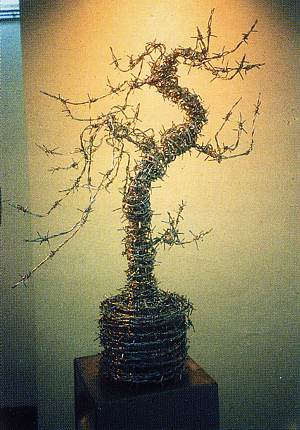
Yet some of “Fake Me” still glittered with many down-reaching meanings engraved on every of its corner, ranging from a barbed wire bonsai, a Zen garden, a floor and a corrugated irin house paved with zinc roofs, to silk cloths embroidered with Haiku poetry. Undoubtedly no one on earth can clarify the definition of “Fake Me” as vivid as its creator, Montri Teomsombat, the latest budding talent who was granted the Japanese Foundation Fellowship in 2000 to conduct a research in Fukuoka, Japan for 6 months.
 |
| Fake Me, 2002 |
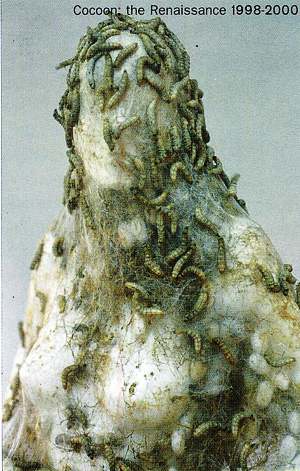
“Fake Me” is a real offbeat costume and performance-installation synthesized from the impact of Montri’s 6-month stay in Japan. Preceding the grant to Japan, Montri has revealed his creativity in many outstanding avant-garde works that are still being broadly touted throughout the international art scene, namely, “Cocoon: the Renaissance” (1998-2000) and “Bangkok Buffalo Boy” (2000-2002).
 |
| Cocoon: the Renaisance, 1998-2000 |
Way before “Fake Me” had succeeded, Montri spent time in Japan attempting to adapt and blend himself wholly into Japanese society and culture in order to learn and have his thoughts and mind smoothly molded to the innermost part of Japanese social structure.
“I was especially into social issues so when it comes to fashion and arts, It is relatively necessary to bring myself closely into a real situation in order to absorb things around me more effectively including the most sensitive part of the people in the society. To do so, I try to clear myself by having my mind cut off from all kinds of thoughts that possibly mislead to confusion. I try to communicate with my feelings instead of words when experiencing anything new.”
“I was there with Mr. Jacques Charrier and we could start traveling around the city and rural area together. We spent time wandering on foot back and forth to unknown places from dawn to dusk. At the same time amid ine silence I noticed that the seed of excitement and doubt started to grow and travel with us everywhere.”
By being dependent on his feeling in absorbing things around. Montri eventually found the merit of stilness, Japanese distinct charater that chiefly inspired him to create this awsome work and, most importantly, became the theme instilled beneath every piece of art works exhibited on that day.
“In my general view as an outsider who is attentively interested in the moment ot quietness in Japanese society, silence can incredibly magnetize one’s feeling and emotion, deliver the suppressive power, and unearth the con-notation hidden beneath its surrounding. I see Japanese society in the moment of on peace and misery simultaneously, so I decided to reflect this in my art work.”
“The odour of stillness and bitter coldness drifting in and out made the viewer to automatically watch every step they made. The recorded sound of the ocean waves flowing against the shore accompanied by the noise of people slowly pacing on the metalled ground, the motionless stand of Bonsai trees, the ici-ness of metal and room’s temperature. The terrifying sharpness against the gentle safety, the artificial house, and the infinity of the horizon inside, altogetner reflect the way people are framed by their own invention. Peace and pain irresistibly creep into the heart. People can do nothing but stand quietly in the midst of quietness. Outside, they may look indifferent but deep down inside… they are burning
Montri’s accomplishment in the past is a vivid reflection of his strong concern for nature and social change. His brilliant way of expressing his experience and personal view makes his art as the crystalline lens that see through everything in a charmingly unsual way.
“For me society and nature are both very good examples and symbols. However, I cannot deny that people actualy have got different living condittions in their life. Sometimes I’m even confused with many of these conditions, but I still try to learn from the suuroundings, in both society and nature, and reflect them through my work. From my prior experience I can say that society and nature teach me to be stronger and brave enough to accept the truth and search for the bliss of life.”
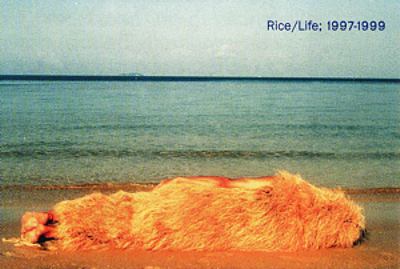
“The process of doing my reseach is to spend even, waking time waiting attentively with an extreme excitement for whatever coming up in front of me. I have been implementing this method in every piece of my work, since planting rice on cloth project (Rice/Life: 1997-1999] to collaborating with silk worm in Cocoon project (Cocoon: the Renaissance 1998-2000), both of which were partially the combination of nature, art, fashion and Buddhist philosophy that I couldn’t tell what would tum out at last.”
 |
| Rice/Life, 1997-1999 |
To discover a new core of life is possibly the fundamental reason of his progressive artistry.
“From the beginning to now my prime motivation of doing art work is to search for the philosophy of how to live my life. Even though my destination is still obscure, it magnetically drives me to keep on searching and letting it go by the tune of life. I have a strong will to build an experience and memory into my viewer’s thinking process without expecting them to be influenced by my own idea.”
The last significant point that Moniri wanted to leave behind after “Fake Me” had been successfully ended was his discoverry during the time he was working on this exhibition.
“The exhibition “Fake Me” has led me to the fact that the barbed wire fenced in our heart can eventually be torn down if we just open our minds. Furthermore, I would like to take this opportunity to show my deep appreciation to the Japan Foundation for offering me a great support from the beginning to the end.”
Deep impression roused by the subtle philosophy of life briliantly reflected through “Fake Me” makes Montri’s next discovery something we must keep an eye on.


 bản để in